.png)
 1 hour ago
2
1 hour ago
2
TCGs (Trading Card Games) can be a dime a dozen and it’s not uncommon for a game to come out and have its popularity die out immediately. Although it’s still unreleased, the Cyberpunk 2077 TCG, developed by WeirdCo and based on the game of the same name, looks like it might be here to stay. I’m not saying that only because it was one of the fastest-backed Kickstarter campaigns, but because I got a hands-on preview of the upcoming game. From what I played, I was immediately drawn into what it has to offer.
With so many different card games on the market, why did CD Projekt Red decide that now was a good time to release a TCG? The short answer was the team’s success with Gwent.
“We’ve always had more ambition when it comes to card games because we love them at CDPR. We have a lot of TCG fans within the studio,” Pawel Burza, senior communication manager at CD Projekt Red, tells me.
The game is rather quick: a standard deck has 40 to 50 cards, no more than three copies of any single card, and a maximum hand size of six cards, with you going against one other opponent. That said, it does take some inspiration from other TCGs like Magic: The Gathering; it has its own version of Commanders that are called Legends, and instead of having one, you have three.
At the start of the game, you put your Legends face down in their own zone and roll a die. The game uses one D4, one D8, one D10, one D12, and one D20. What’s unique about this game is that a large part of the mechanics are built around rolling dice, and oftentimes it doesn’t matter if you roll high or low.
The second a die is rolled, the clock starts ticking. The second you reach round seven, the game concludes unless you reach sudden death. In that case, it’ll end at round eight.
“We’ve really tried hard to prioritize having a speedy game experience while still feeling like your skill expression is the most important part when determining who wins the game of Cyberpunk,” Richard Zapp, head of game design at WeirdCo, tells me. Burza echoed that statement, explaining that the plan also aimed to ensure that big tournaments, such as regionals, could be played as quickly as possible.
Zapp goes on to explain that this is one of the main things that set the Cyberpunk TCG apart from other games in the space. Right off the bat, players know when the game will end, and, on top of the dice (gig) system, it adds a certain chaotic flair not seen elsewhere.
The dice are also supposed to represent Night City itself. Each time one is rolled, it tells you how many gigs are available to you. At the start of the game, you’ll have three eddies (resources) that can be used to play cards. If you want more, you can sell a majority of your cards and use them to play more cards as the game goes on. So, oftentimes, it’s in your best interest to sell a card if you have two in your hand. This feature mimics the game by allowing you to sell gear you’re not using to vendors.
If you have enough eddies, you can use them to reveal your Legends so that you can prepare to use them in future turns. Like most TCGs, certain cards allow you to perform specific actions like preventing damage and buffing other ones in play. Once the board is set up, you have several options. You can either attack the enemy player’s cards or go after their gigs.
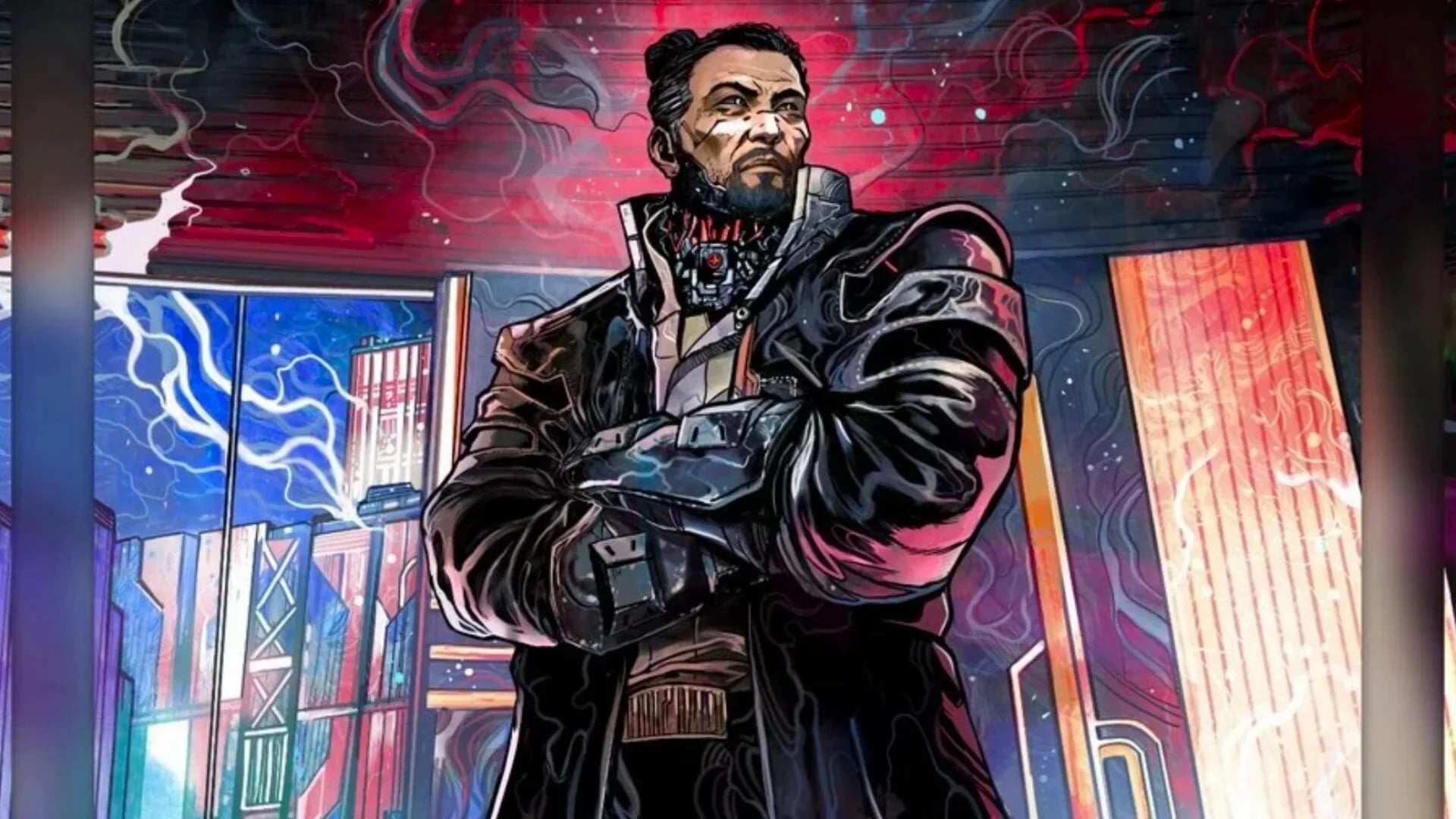 © WeirdCo
This is where much of the strategy comes into play, because, like Commanders in Magic: The Gathering, your deck is built around your Legends. The dice you roll will often play a big part in what you do in a certain turn and can help when it comes to building combos. The second someone starts a round with seven gigs, they win the game. Even though you automatically gain a gig at the start of each round, it can be in your best interest to take out your opponent’s cards to prevent them from stealing gigs from you.
That’s exactly what I found myself doing while I was playing. This was because my opponent was primarily targeting my gigs, leaving them wide open to attacks. While I was letting him build up a small fortune, I was planning on taking out his grunts to prevent them from getting richer and winning the game.
Although the plan was risky, it allowed me to build up a small gang of my own. This was largely thanks to my Legends, whom I had played earlier in the game. The first was Jackie Welles; his ability allowed me to lower my dice count, and the second was that once it reached 1, I could draw another card. The color combination for my deck was Blue (Intelligence) and Yellow (Dexterity). At the same time, my opponent had Red (Body) and Green (Reflect). Zapp revealed that all the colors in each deck were meant to reflect the skill trees you can choose while playing the 2077 video game.
The idea was to keep drawing cards in hopes of selling them off; the one-two punch was allowing me to play the other Legend V. When she reached a certain power level, I was able to steal two gigs instead of one.
After exchanging a few blows with my opponent and building up enough gang members, we found ourselves in sudden death. This was because, by the start of turn seven, neither of us had begun the round with seven gigs.
The rules for sudden death are fairly simple, too. Whoever gets seven gigs first wins the game, no matter what. Luckily, the second we entered sudden death, I was first to go. All that was left for me to do was spend a few resources to buff the cards I had in play, and take the win. That’s exactly what had happened.
If you’ve ever played a TCG for the first time, or in general, you’ll know that a single game takes up a lot of time. But to my surprise, a full game took us roughly 20 minutes, including time for the team to explain the core rules to me.
That’s another thing, too: a lot of TCGs can often get a little too carried away with text on the cards (I’m looking at you, Magic: The Gathering), and it can often feel as if you’re reading a minibook. But that wasn’t the case for Cyberpunk. Many cards feature only a handful of words. Whenever mechanics do need to be broken down, it’s right to the point.
Mechanics aside, the artwork is nothing less than great. As a giant Cyberpunk sicko, I was able to spot artwork that mirrored specific comic book runs such as Blackout. The team at WeirdCo essentially had full access to the CD Projekt Red art vault and could use or recreate specific artwork across many different cards. After all, having pretty cards to look at is half the battle when it comes to making sure a TCG game takes off.
“At the end of the day, it’s all Cyberpunk, and it’s all an authentic representation of Night City.” WeirdCo creative director Jonny Erner tells me. One of the ways they want to do that is by exploring how to bring various Cyberpunk media into cards, whether through in-game screenshots, comic book covers, or original art.
The cherry on top is that if the card is red-based, that’ll be most of the art’s color scheme, and it’s fun to see how the team uses that to really make them pop. The same can be said of all the other color types.
“Some of the most fun characters in card arts are where we’re kind of playing with that expectation a little bit,” Erner says. “So, you might have a predominantly red card. Corpo V is a good example with this really dramatic red lighting all over V, and it’s on a blue frame. It creates this really striking visual contrast.”
Even though I was only able to play a single game, it did get me hungry to play more once the game is fully released later this year. This is a game I can easily see myself spending more money on than I’d like to admit and getting lost chasing the meta. Plus, it’s not every day that a TCG based on your favorite IP comes out.






![ELDEN RING NIGHTREIGN: Deluxe Edition [FitGirl Repack]](https://i5.imageban.ru/out/2025/05/30/c2e3dcd3fc13fa43f3e4306eeea33a6f.jpg)
 English (US) ·