.png)
 7 months ago
99
7 months ago
99


A tribute to the weird and twisted history of Santa Claus slashers and other Saint Nick horror movies
 Image: Grant Walkup/Polygon
Humans have an undeniable talent for transforming anything wholesome into its evil mirror image. Case in point, Hollywood is currently hard at work on a teddy bear-inspired horror cinematic universe. But decades before Winnie-the-Pooh: Blood and Honey graced your local cinema, gore-obsessed filmmakers turned their attention to another beloved character: Santa Claus.
In a way, it makes sense. Long before he became the world’s go-to distributor of joy, Saint Nick was hanging out with Krampus, the original “bad cop” of Christmas. But the full-blown corrupted Santa — the one who ditches the milk and cookies in favor of hunting knives and shotguns — forces us to ask a far more disturbing question: What if Santa started dishing out punishments for the naughty himself?
Like so much else that defines modern pop culture, the concept of a homicidal Santa Claus has its roots in a comic book; specifically, the 1954 EC Comics classic Vault of Horror #35 story “…And All Through the House.” Written and illustrated by Johnny Craig, it follows a woman who has just murdered her husband on Christmas Eve, only to find herself stalked by an escaped lunatic dressed as Santa. Unable to call the police without exposing her own crime, she desperately tries to keep him out of her home. The tale ends ironically when her young daughter, believing the killer is the real Saint Nick, invites him inside.
Eighteen years after “…And All Through the House” first appeared in comic form, the story was adapted for the screen in 1972’s Tales of the Crypt, based on classic EC Comics horror tales, produced by British anthology specialists Amicus Productions. This marked the big screen’s first accurate portrayal of a killer Santa, launching a cinematic tradition that continues to this day.
In the half-century since, the concept of an evil, murderous Santa Claus has inspired at least a handful of cult classic films. The subgenre has wormed its way into pop culture, too, from A Nightmare Before Christmas to Futurama. But in its purest form, killer Santa is still the stuff of nightmares.
So, as society collectively settles into a cheery Christmas stupor, join Polygon as we revisit the essential movies that make up the Evil Santa Canon. If the holiday season ever feels like too much, these films will set you right — just don’t try putting them on in front of your normie friends and family members, or you may not get invited back to the holiday party next year.
Tales from the Crypt (1972)
 Image: The Everett Collection
Tales from the Crypt (1972) is an anthology film featuring five stories, all directed by Freddie Francis, the best of which is “...And All Through the House.” In the 12-minute short, five strangers (Joan Collins, Ian Hendry, Robin Phillips, Richard Greene, and Nigel Patrick) wander into a crypt, where a mysterious Crypt Keeper (Ralph Richardson) forces each of them to witness their fate. Collins, who plays Joanne Clayton, is shown a future where she kills her husband on Christmas Eve and is stalked by a lunatic dressed as Santa.
It begins and ends just as it does in the original comic, and nails what makes Santa and horror such an effective pairing: the perversion of innocence. Joanne’s daughter can’t see Santa as anything but a figure of good, despite the knife in his hand and blood on his wardrobe. Just as she couldn’t imagine her own mother capable of violence, she can’t comprehend a murderous Santa.
“...And All Through the House” is one of the first depictions of a killer Santa on screen, and it's still one of the best. The premise was later used in the Tales from the Crypt television series as well as in an episode directed by Robert Zemeckis (Back to the Future, Forrest Gump), but the original film’s emotionless depiction of the lunatic killer suits the story better than the television adaptation, and a shorter runtime works better for this brutal, simple story. —Isaac Rouse
Christmas Evil (1980)

Michael Jackson caught his mama kissing Santa Claus and turned it into a hit song with his brothers. Harry Stadling (Brandon Maggart) sees his mom doing… a spicier version of that, and his life takes a much darker turn. As an adult, Harry channels that trauma into spying on neighborhood kids with binoculars, keeping a meticulously judgmental naughty list, and clocking in at a toy factory. About two-thirds into the movie, after plenty of atmosphere and a surprisingly decent sob story showcasing how he’s bullied at work, the murders finally begin.
Harry slips into a Santa suit, breaks into houses, drops off presents, crashes Christmas parties, and generally shambles around like Dan Aykroyd in Trading Places, all while knocking people off along the way. It’s wild because Harry mainly kills awful people, so after a while, you kind of start rooting for him.
Director Lewis Jackson draws a clever distinction between the way everyone seems to loathe Harry and the unconditional love he receives while dressed as Santa Claus (before he starts killing people). There’s something to be said here about how folks are quicker to embrace mascots than their fellow human beings, or how altruism only applies during the holidays. However, all social commentary is thrown out the window once the ending approaches.
Christmas Evil caps things off with one of horror cinema’s all-time “did that really just happen?” endings. It’s undeniably strange, but that’s precisely what makes it so compelling. It’s not about revenge or simply being a psychopathic killer like so many Santa slasher movies. Jackson’s not here for simple sleigh-bell carnage. Instead, he’s asking people to consider the mentally ill, the homeless, and sick children during a holiday that’s supposed to be about charity and hope. The film demonstrates what could happen if one of those people finally breaks bad because they don’t fit the traditional Hallmark mold of the season. It's my personal favorite Santa slasher because of it. —Isaac Rouse
Silent Night, Deadly Night (1984)

Despite being released four years after Christmas Evil defined the subgenre, Silent Night, Deadly Night is viewed as the quintessential Santa slasher because of its marketing campaign ads and the controversy they generated. When Silent Night, Deadly Night debuted in 1984, its ads plastered a killer Santa with an axe across TVs during family programming. Parenting groups and even some movie critics protested outside theaters. News stations covered the controversy, and the film was quickly pulled from theaters. The outrage became a national story, whereas Christmas Evil had gone relatively unnoticed.
Another reason Silent Night, Deadly Night overshadowed Christmas Evil is that it leaned more into horror tropes, despite still featuring a prominent psychological angle. The mid-1980s were the peak slasher era (post-Halloween, Friday the 13th, Nightmare on Elm Street), and audiences were trained to respond to simple, violent concepts. Director Charles E. Sellier Jr. delivered, weaving in an unintentionally campy atmosphere that rewards repeat viewings.
After witnessing his parents’ murder by a man in a Santa suit, Billy Chapman (Robert Brian Wilson) grows up traumatized and abused in a Catholic orphanage that ignores his fear of Christmas. Years later, Billy is living a relatively normal life and working in a toy factory, but when he’s forced to dress up as Santa at his job, he snaps and embarks on a violent Christmas Eve rampage, “punishing” anyone he deems naughty. His path of destruction leads him back to the orphanage.
Released by Tri-Star Pictures on November 9, 1984, Silent Night, Deadly Night received mixed reviews and was pulled from theaters just a week later. Despite the controversy, it was a box office hit during its opening week, earning $2.5 million on a $750,000 budget. Over the years, it’s gained a devoted cult following and spawned four sequels, the fourth and fifth of which are unrelated to the original, as well as a loose 2012 remake. The latest reboot arrives this month. —Isaac Rouse
Deadly Games (1989)

Deadly Games isn’t as much of a cult classic as the films mentioned above; this French film continues the trend of holiday horror slashers to close out the 1980s. Released five years after Silent Night, Deadly Night, it capitalized on the Santa-slashers-as-controversy formula. But unlike Silent Night, which gave its killer psychological depth, Deadly Games leans into a more straightforward home-invasion premise — masked killer, a series of murders, suspenseful set pieces — while still using Santa as a symbol of twisted morality.
In many ways, Deadly Games mirrors Home Alone’s setup, though with far darker stakes. The film centers on a vagrant in a Santa suit committing a home invasion during the holiday season. Like Kevin McCallister defending his house from burglars, kid genius Thomas de Frémont (Alain Lalanne) goes full Rambo and weaponizes his home to fend off this murderous Saint Nick, but here the threat is lethal rather than comedic. (One booby trap involves a live grenade attached to a toy train.)
The film’s French writer-director, René Manzor, actually threatened to sue the creators of Home Alone because, according to him, they “remade my movie” a year later. More than anything, however, Deadly Games demonstrates how the idea of a killer Santa was spreading beyond one controversial film into a mini-subgenre. —Isaac Rouse
Santa Claws (1996)
 Image: American Home Entertainment
As pop culture left the ‘80s, so too did we leave behind the idea of Santa slashers. In the irony-obsessed ‘90s, it was more entertaining to see Saint Nick as a mean drunk, as proven in Trading Places and Bad Santa (more on those two below) than a killer.
Santa Claws is a low-budget, direct-to-video holiday slasher written and directed by John A. Russo. Yes, the same Russo who co-wrote the legendary zombie classic, Night of the Living Dead. Despite that pedigree, this movie is a mid-’90s shot-on-video oddity rather than a polished horror production.
The story follows a mentally unstable man named Wayne (Grant Kramer) who becomes obsessed with a B-movie scream queen and begins killing people while dressed in a black Santa suit. It’s very exploitative with plenty of campy scenes, borderline softcore porn, and stilted dialogue. Santa Claws had a tiny budget, the acting comes off as fake, and the kills look cheap. Over the years, the movie has gained a small cult following — not because it’s good, but because it’s such a strange, earnest attempt at a Christmas slasher from an iconic horror figure working far outside his prime. —Isaac Rouse
Santa’s Slay (2005)

First (and only) time director David Steiman aligns the killer-Santa subgenre more closely with comedy. The movie opens with a deliberately over-the-top celebrity cameo massacre (featuring Fran Drescher, Chris Kattan, and James Caan), setting the tone for the rest: loud, chaotic, and knowingly dumb.
Santa’s Slay stars professional wrestler Bill Goldberg as Santa, which should tell you all you need to know about its quality (this was long before the WWE-star-to-serious-actor pipeline was a real thing). He’s reimagined here not as a jolly gift-giver, but as a demonic being who lost a bet with an angel and was forced to spend 1,000 years delivering presents instead of killing people. It’s got more in common with Jack Frost (albeit with a bigger budget) than it does horror, and is probably best viewed with some spiked eggnog and special brownies.
Then again, seeing Goldberg in a Santa suit busting through chimneys, doing acrobatics across the dining room table, and calling waitresses hoes is about as funny as it gets — especially if you’re a wrestling fan who just watched him retire earlier this year.
It’s not aiming to be scary, but it’s a cult-favorite party movie, perfect for throwing on with friends thanks to its hilariously over-the-top kills, constant winks at the audience, and easy slot in any holiday-season rotation. — Isaac Rouse
Saint (2010)
 Image: IFC Films/Everett Collection
Saint (or Sint, as it was titled in the Netherlands) takes the idea of evil Santa Claus in a more supernatural direction. Riffing on “Sinterklaas,” the pre-Coca-Cola commercial iteration of Saint Nick who originated in Europe, director Dick Maas conjures a murderous ghost named Niklas who resurfaces every few decades to get revenge on the town that killed him.
The film opens in December 1942, when ex-bishop Niklas (Huub Stapel) and his violent gang are killed at the hands of some fed-up villagers. Unfortunately for that small Dutch village, any year where the anniversary of the event coincides with a full moon causes Niklas and his gang to come back as bloodthirsty ghosts. This occurs roughly every 32 years, so by 2010, most locals assume it’s just a superstition. So naturally, that’s when Santa returns.
Despite some decent digital and practical effects, there’s not much to Saint. If you want to watch an evil Santa with a messed-up face kill a bunch of people, this movie does the trick, but it doesn’t have much else to say about the commercialization of Christmas, which feels like a missed opportunity for a film about the pre-capitalism version of Saint Nick coming back for revenge in modern Europe. —Jake Kleinman
Silent Night (2012)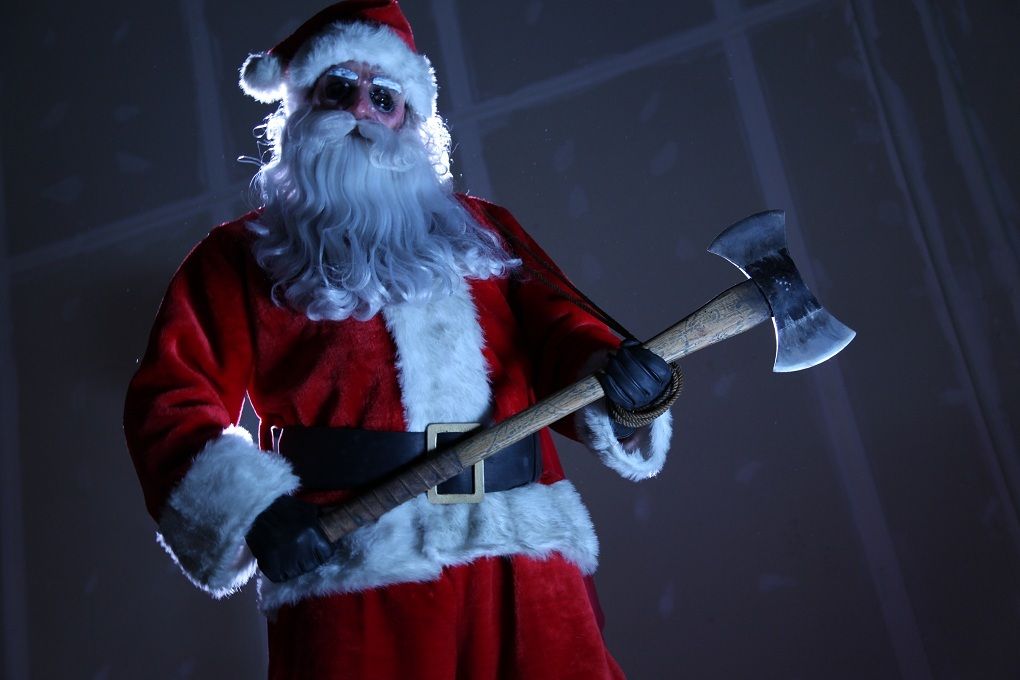
Silent Night is technically a remake of the 1984 genre-establishing cult classic. But aside from the name and the concept of a serial killer dressed as Santa Claus, the two films don’t have much in common. Screenwriter Jayson Rothwell never even saw Silent Night, Deadly Night. Instead, he apparently based his story on a real-life murder that occurred a few years earlier on Christmas Eve.
Silent Night inverts the original concept, turning the straightforward slasher into a violent whodunnit. The final twist is satisfying enough, and the thrill of watching Santa Claus murder people still holds (even if this Santa is wearing a creepy mask), but the original movie’s ‘80s charm mostly gets washed out in favor of early-2010s edginess.
Then again, this is also a movie where Malcolm McDowell plays a sheriff who says things like “Christmas! The number one holiday for people going nuts” with a totally straight face. That’s gotta count for something. —Jake Kleinman
Christmas Bloody Christmas (2023)
 Image: Shudder
How do you keep the Santa slasher fresh after 51 years? If your answer was Make Santa Claus a killer robot, then this is the movie for you. Directed and written by Joe Begos on a tiny budget, Christmas Bloody Christmas takes the original concept and strips it down to the nuts and bolts — literally.
The film takes place entirely on Christmas Eve, opening with a news broadcast announcing that a robotic Santa Claus toy has been recalled because it keeps glitching and reverting to its original programming as a U.S. military experiment. Why is the army reselling killer robots as Christmas toys? Don’t worry about it.
Of course, it doesn’t take long before one of those toys malfunctions, killing two toy-store employees while they’re having sex. It then goes on a killing spree across town that includes a shootout with the cops and a scene in which robot Santa drives a stolen ambulance into a police station. In other words, this is a very dumb movie. It also rules.
By turning the killer into a robot, Christmas Bloody Christmas removes the psychological element that drives so many of these films. What’s left behind is pure holiday mayhem. A Santa slasher in its purest form. —Jake Kleinman
Honorable mentions
 Image: Paramount Pictures/Everett Collection
While these don’t technically make the cut as canonical “Evil Santa” movies, they’re worth mentioning as part of the discussion.
Trading Places (1983): Although this John Landis-directed classic starring Eddie Murphy and Dan Ackroyd doesn’t feature a killer Santa, it is one of the first depictions of a drunk one, which went on to carve out its own distinct sub-genre. Louis Winthorpe (Ackroyd) is very much the original Bad Santa, who, after losing his job and wealth due to a petty scheme by his bosses, goes off the deep end and dons a Santa suit while wielding a gun in their office. His time as Santa is an extended sequence that has no further bearing throughout the film, but is still one of its most memorable and influential moments.
The Nightmare Before Christmas (1993): This kid-friendly stop-motion classic from director Henry Selick and producer Tim Burton doesn’t exactly feature an evil Santa Claus, but it does imagine a world where ghouls and monsters take over Christmas. If your audience includes any kids, this beloved Disney movie is a sneaky back door to introduce them to the concept of evil Santa, so you can follow it up with a real slasher once they’re old enough.
 Image: Buena Vista Pictures/Everett Collection
Futurama (1999): Before Christmas Bloody Christmas, Matt Groening’s science fiction comedy nailed the concept of an evil Robot Santa (voiced by John Goodman). The character first shows up in a classic season 2 episode, “Xmas Story,” revealing how a computer error caused this automated Saint Nick to judge all of humanity as naughty.
Bad Santa (2003): Two words — “Santa fucks.” That’s the premise of this early-2000s comedy cult classic starring Billy Bob Thornton as a mall Santa Claus who steals from his employers. He’s no serial killer, but he’s not exactly a good guy either.
 Image: Dimension/Everett Collection
Krampus (2015): Director Michael Dougherty brings the folktale of Krampus, a monster that works with Santa Claus to punish the naughty, to life in this mid-budget horror comedy. It’s not exactly evil Santa, but Krampus has some genuine holiday scares and an impressive cast that includes Adam Scott and Toni Collette.
Violent Night (2022): What if Santa was a good guy who also killed people? And also played by David Harbour? That’s the elevator pitch behind this surprisingly fun action thriller, which has a sequel planned for 2026.
The Evil Christmas Canon is a tradition that continues to evolve with every generation. Have suggestions? Let us know in the comments, and we’ll consider them for a future update.






![ELDEN RING NIGHTREIGN: Deluxe Edition [FitGirl Repack]](https://i5.imageban.ru/out/2025/05/30/c2e3dcd3fc13fa43f3e4306eeea33a6f.jpg)
 English (US) ·