.png)
 3 hours ago
3
3 hours ago
3
Between 2013 and 2014, solo developer Matthew Brown stepped out from the shadows and released a trilogy of completely unique puzzle games: Hexcells. All three entries came out within the space of a year, and each was significantly better than the last. And the first was already incredible. Over a decade later, nothing else has come close to delivering the same astonishing quality, deeply satisfying challenge, and aural delight.
I’ve long been a passionate consumer of logic puzzles. From Mario Picross to embarrassing hours spent watching Cracking the Cryptic, these methodical challenges require of me no general knowledge, ask for no understanding of math or language, but instead demand just calm, intelligent unpacking. Sudoku doesn’t particularly appeal to me, but Picross, Slitherlink, Mosaic, Campixu, Kakuro…inject them directly into my veins. Hexcells, with its combination of Picross, Mosaic and Minesweeper, was so refreshingly interesting, and such a constant pleasure to solve.
 © Matthew Brown / Kotaku
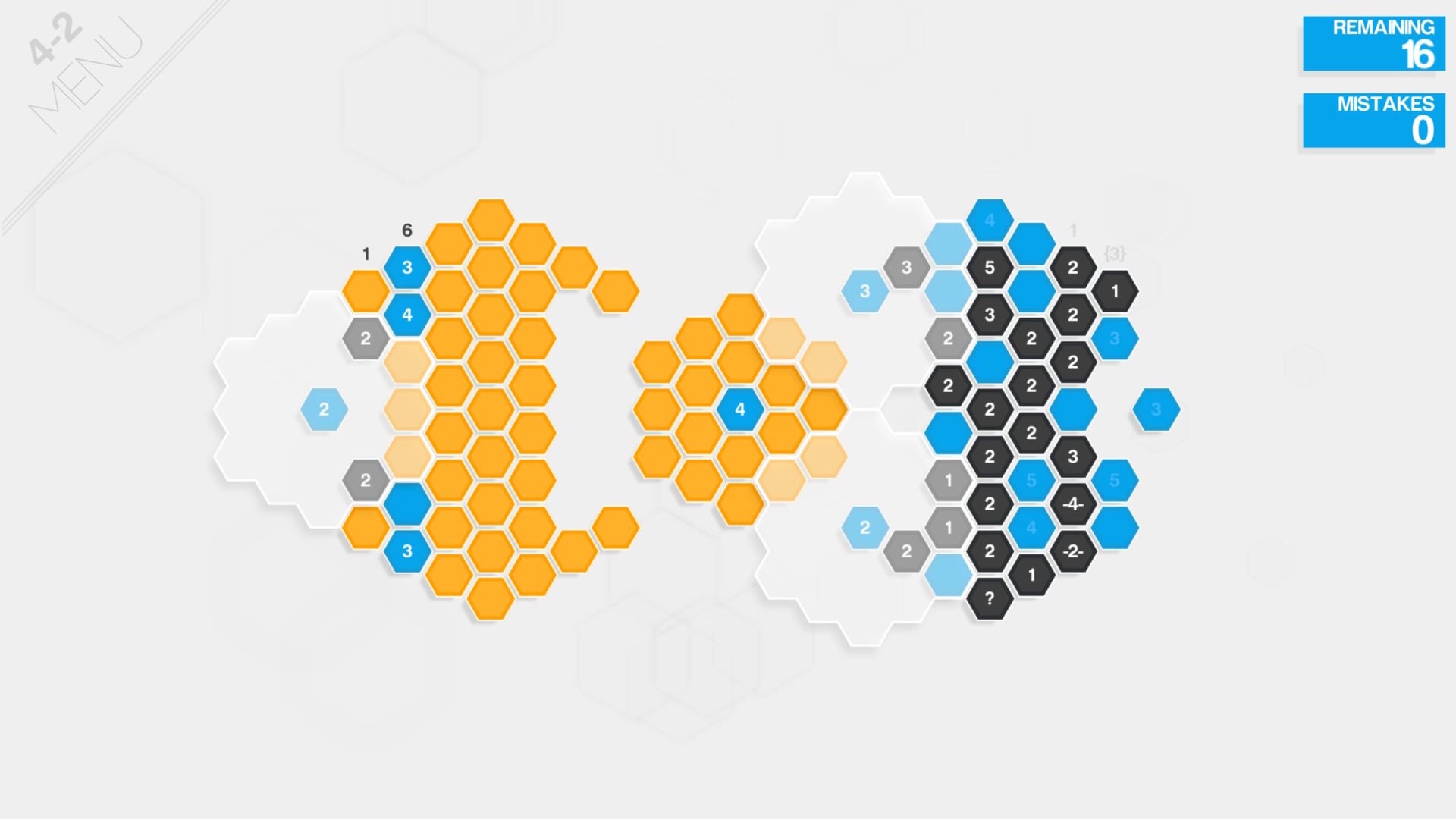
Explaining these things in words is always an ordeal, so bear with me. In a Hexcells puzzle you begin with a tiled grid of mostly orange hexagons and a few hexagonal cells containing guiding numbers. If a cell has a 3, for instance, that means three of the adjacent cells need to be colored blue, and therefore three need to be deleted. If it’s a 0, that’s a gimme that tells you to eliminate all six cells that touch it. Doing so will reveal new numbers (or “?” for when you don’t need to know), prompting you onward. Of course, figuring out which cells are colored is the rub, and this involves taking into account multiple sets of information and fathoming how they intersect.
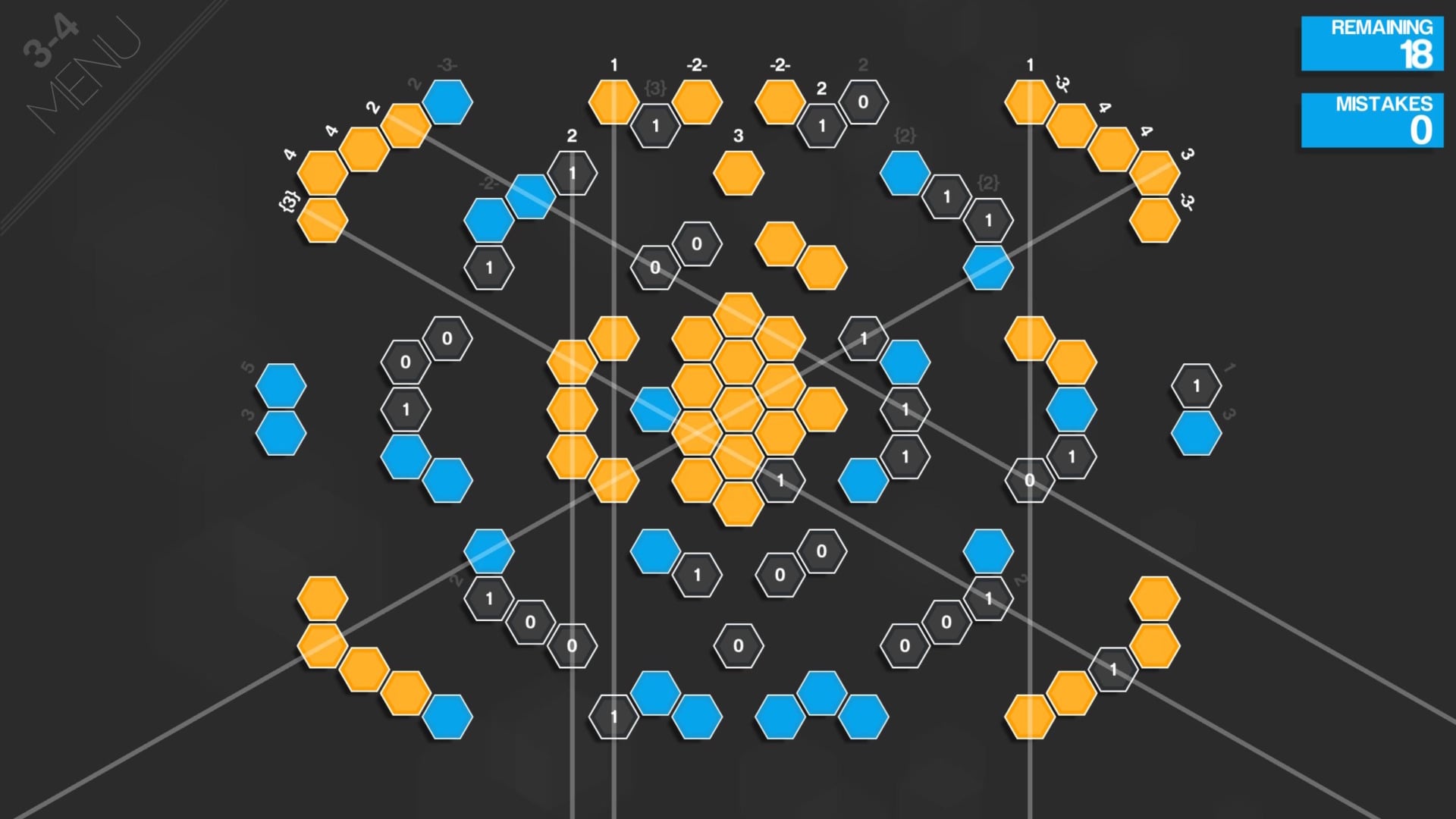
As you play, new rules are introduced, such as Picross-like numbers at the top or diagonal ends of rows that tell you how many tiles are blue in that straight line, special cells that highlight the 18 cells that surround them and tell you now many of those are blue, and bracketed numbers which impose even more rules. “[2]” means two cells are blue but cannot touch each other, while “{2}” means they must touch each other.
 © Matthew Brown / Kotaku
As a puzzle that can only work on computer, given the way in which new information is revealed as you highlight or destroy its hexagonal tiles, Hexcells is a visual and aural delight. Your every click dings and dongs tunefully in such a way that it mixes into the soundtrack, while its clear, exquisite art offers modest polygonal shattering when you eliminate a cell. The ambient interactive soundtrack is deeply relaxing, and everything feels designed to make you feel as comfortable as possible. Or, well, as comfortable as you can be when you’re pulling at your hair, trying to spot the clue you’re currently missing.
When Hexcells released in September 2013, it was a revelation (it came to Steam a bit later, hence the date differences). Its only failing was that it was perhaps a little too easy. But that would prove a very temporary issue, because just three months later appeared Hexcells Plus, another 29 puzzles that picked up where the first game left off. And it was just blisteringly great. Adding in the new rules and lifting the difficulty level significantly, this very quickly became my favorite puzzle game of all time. For six months.
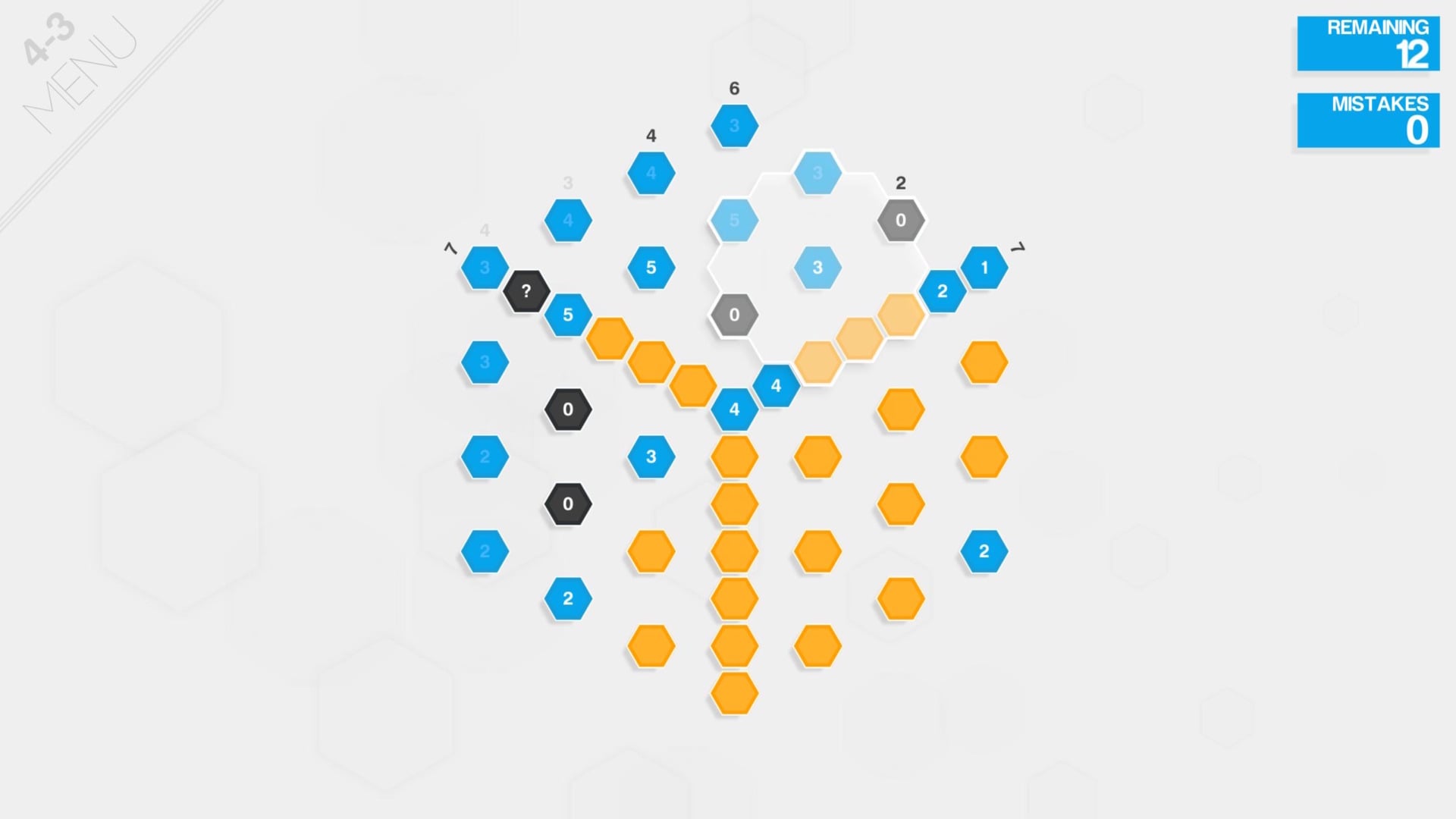
Because on September 1, 2014, Hexcells Infinite came out, at which point I ran out of superlatives. Infinite took the challenge to its absolute perfect peak, being by far the hardest of the trilogy, but also always fair. The grids get larger or, in especially cruel puzzles, smaller, but much more importantly, they get more interesting. It’s hard to explain without sounding like a mad fool how witty some of these puzzles feel. It’s like Brown is toying with you, deliberately pulling your strings with his design and structure. And the way Infinite re-teaches the rules through challenging puzzles rather than overt explanations is sublime.
 © Matthew Brown / Kotaku
Brown went on to make some similar games, SquareCells and CrossCells, which are both also well worth playing, and then made two very different puzzle games that were so incomprehensibly difficult that he lost me entirely, Cypher and Alchemia. Then there was nothing for six whole years! But in 2024 the developer returned with yet another hugely difficult and intriguing game, Epigraph, about deciphering a brand new language. But I still desperately yearn for the day when he reappears with another 2D logic puzzle game that reshapes my brain in a whole new way. Other games have helped me cope, not least Tametsi, but there’s still nothing as purely perfect as Hexcells.
The best thing is, you can pick up all three of the Hexcells trilogy for only $9, which is a ludicrously good deal. I really cannot recommend them enough. But will keep trying for the rest of time.








![ELDEN RING NIGHTREIGN: Deluxe Edition [FitGirl Repack]](https://i5.imageban.ru/out/2025/05/30/c2e3dcd3fc13fa43f3e4306eeea33a6f.jpg)
 English (US) ·