.png)
 5 months ago
58
5 months ago
58

Published Feb 10, 2026, 12:00 PM EST
Gore Verbinski’s new sci-fi movie is also a blatant Terminator ripoff, but in a fun way
 Image: Briarcliff Entertainment
Remember when Black Mirror was good? Not just decent or occasionally poignant and a little bit spooky, but actually excellent techno-dystopian storytelling? Well, apparently Gore Verbinski remembers, because his latest film feels like watching the best new episode of Black Mirror since Netflix took over the franchise in 2015.
Directed by Verbinski (Pirates of the Caribbean, The Ring, Rango) with a script from Matthew Robinson (Love and Monsters), Good Luck, Have Fun, Don’t Die smushes a handful of Black Mirror-esque dystopian tech vignettes into one, mostly coherent narrative. The film’s central story of a time-traveling hero sent to our present to stop an AI apocalypse has extremely unsubtle Terminator influences. But told through the lens of Verbinski’s slapstick sensibilities, Good Luck becomes both wildly original and wildly entertaining, even as it begins to break from reality in a messy final act.
Good Luck, Have Fun, Don’t Die begins in a diner. It’s the kind of classic, stereotypical American establishment we’re all deeply familiar with, but even before the film’s star, Sam Rockwell, shows up to warn the restaurant’s occupants about the apocalyptic future that’s about to become inevitable, something seems off. Under the diner’s sterile fluorescent lights, Verbinski depicts another familiar scene: a crowd of strangers all blankly mesmerized by their glowing smartphone screens. Our world is already broken, and that only becomes clearer as the story progresses.
Rockwell dominates the screen from the moment he steps into it. Clothed in a transparent raincoat and a tangle of interconnected tubes and wires, he bursts into the diner and demands the crowd’s attention. The world is about to end, and he wants volunteers to help save humanity from an AI singularity apocalypse. Rockwell struts across the restaurant and leaps from table to table as he monologues through Good Luck’s first big exposition dump, occasionally grabbing a smartphone out of someone’s hands and disposing of it (for instance, by tossing it across the room into a boiling pot of soup) to emphasize his anti-technology ravings. His performance is reminiscent of the Pirates movies’ Captain Jack Sparrow (a comparison Verbinski endorses), with the same mix of operatic flair, effortless charm, and unabashed narcissism that made Johnny Depp’s rip-roaring anti-hero an international icon.
In this case, that narcissism is merited. As Rockwell’s unnamed time traveler explains, he’s trying to save the world by installing specially designed safety protocols into the computer of a 9-year-old genius who’s just 60 minutes away from creating the AI that enslaves humanity. To pull this off, our hero needs to assemble just the right combination of the diner’s customers for a dangerous crosstown journey, during which they’ll encounter hit men, killer cops, and far worse. He's frank, even casual, about the fact that he's attempted this many times before, and that his volunteers may die along the way, while he escapes back into the time stream to try again.
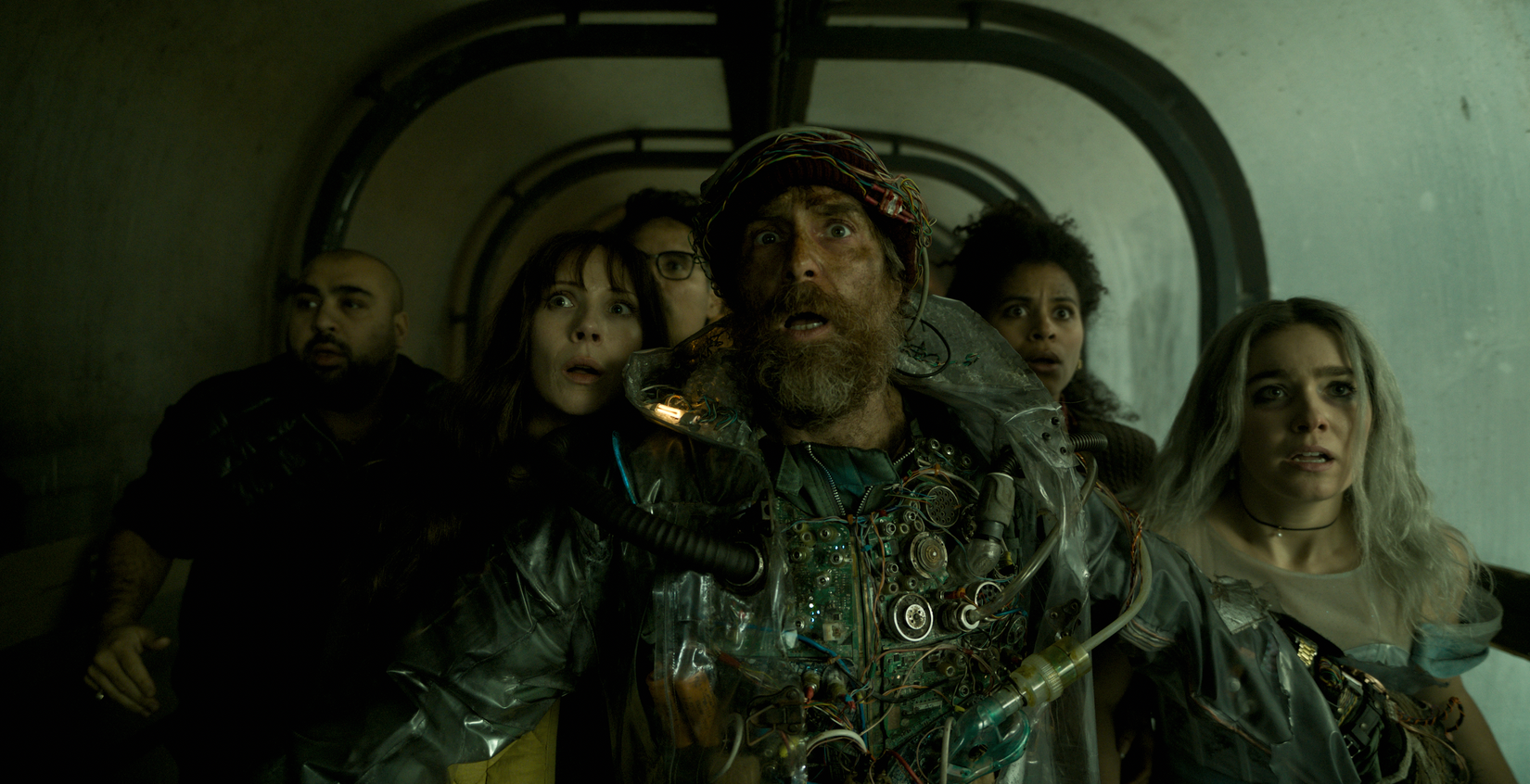 Image: Briarcliff Entertainment
If the above sounds like the ravings of a madman, well, you’re not wrong, and the rest of Good Luck’s characters spend most of the movie questioning whether anything Rockwell says is even the slightest bit true. But as the story moves forward, a series of flashbacks reveal that their world is already going through calamitous technological shifts into dystopic science fiction realms. Presented at pivotal moments throughout the film, each flashback (covering anywhere from several years to just a few days) shows how Rockwell’s recruits have gone through their own techno-horror experiences before joining this seemingly delusional man on a life-threatening quest.
Each flashback also feels like its own little Black Mirror episode, tackling topics like teenage smartphone addiction and virtual reality, while Verbinski leans into various genre tropes to give Good Luck an anthology feel. In one sequence, a throng of high school students chase their teachers through the school like a horde of zombies. Another becomes a heartbreaking romance, while the grimmest flashback takes on America’s school shooting epidemic with a dark sci-fi twist, before somehow delivering the film’s funniest moment. Each of these vignettes builds on on what came before, slowly painting a picture of a tech-addicted world where smartphones and algorithms have already sapped us of our humanity even before artificial intelligence ever poses a physical threat.
 Image: Briarcliff Entertainment
Good Luck’s final act lurches from dystopian action comedy into absurdist spectacle. As the final confrontation looms, reality itself seems to snap. Robinson doesn’t offer many answers in his script, instead delighting in the logic-breaking freedom of concepts like time-travel loops and all-powerful AI. But Verbinski imbues the film’s climax with a visual language that paves over any narrative holes. As the story gives way to surrealism, the director reaches into a grab bag of VFX tricks, ranging from stop-motion-esque animation to stunning, AI slop-inspired visuals. It all combines into a Frankenstein’s monster of special effects that’s utterly captivating and eerily beautiful. In addition to its many other strengths, Good Luck, Have Fun, Don’t Die is a reminder that big-budget blockbuster CGI doesn't need to look as sloppily animated as it frequently has in recent years.
Good Luck is undeniably a messy shaggy dog of a movie, but it’s a beautiful mess. It’s a timely plea for humanity to snap out of our collective tech-enabled stupor before it’s too late, if it isn’t already. It's Terminator with slapstick comedy. It’s a season of Black Mirror with an overarching plotline that sort of mostly makes sense.
But unlike Netflix’s sci-fi anthology, which so often succumbs to scoldy tech parables or zeitgeisty twists too clever for its own good, Verbinski finds just the right balance between horror and comedy, between fiction and reality. For a movie with a farfetched premise that only gets weirder as its story progresses, Good Luck’s greatest strength is just how real that world feels even as it collapses into chaos.
Good Luck, Have Fun, Don’t Die releases in theaters on Feb. 13.




![ELDEN RING NIGHTREIGN: Deluxe Edition [FitGirl Repack]](https://i5.imageban.ru/out/2025/05/30/c2e3dcd3fc13fa43f3e4306eeea33a6f.jpg)
 English (US) ·